


Why regulation can be harder for some neurodivergent children
Every child is different, and a diagnosis tells us little about an individual child’s needs. But schools often notice some common patterns among neurodivergent pupils that can make regulation harder:
- Sensory differences. Noise, lighting, crowded spaces, textures or smells that other children barely notice can be overwhelming, leaving less capacity to cope with other demands.
- Recognising internal signals. Some children find it harder to notice the early physical signs of a rising emotion, such as a racing heart or tense muscles, so feelings seem to arrive suddenly and intensely.
- Communication. Children who find it harder to put feelings into words may express distress through behaviour instead.
- Uncertainty and change. Unexpected changes to routine can cause significant anxiety for some children.
- Attention and impulse control. Children who find it harder to pause before acting may react quickly to frustration, before they have had a chance to use a strategy.
- Cumulative stress. Some children hold themselves together during the school day and release the build-up of stress later, often at home. Families may see a very different picture from school.
Understanding these patterns helps adults respond with curiosity rather than frustration, and adapt the environment as well as the child’s support.
The case for a universal approach
It can be tempting to think of regulation support as something only certain children need. But the strategies that help neurodivergent pupils most, such as clear routines, explicit teaching, visual supports and calm, predictable adults, benefit every child.
The Education Endowment Foundation’s guidance on special educational needs in mainstream schools makes this point clearly. It recommends that schools focus on high-quality teaching for all pupils, using approaches such as explicit instruction, cognitive and metacognitive strategies, scaffolding, flexible grouping and technology, which are particularly helpful for pupils with SEND and benefit their peers too.
The SENCO at St John’s CofE Primary School summarises the principle: “What is good practice for SEND is good for all after all.”
A universal approach also matters because many children with regulation difficulties do not have a diagnosis, or are waiting for an assessment. The SEND reforms set out in the 2026 Schools White Paper emphasise support that does not depend on a diagnosis. Teaching every child about their emotions means support is already in place when a child begins to struggle.
Teaching children about their brain
One of the most effective foundations for regulation is helping children understand what happens in their brain when they feel strong emotions. When children learn, in simple and age-appropriate terms, that part of their brain is designed to keep them safe, and that it can sometimes react quickly before the thinking part of the brain catches up, their feelings start to make sense.
This understanding has several benefits:
- it reduces shame, because children learn that big feelings are a normal brain response, not a sign that they are “naughty”
- it gives children and adults a shared language for what is happening
- it explains why calming strategies work, which makes children more likely to use them
For neurodivergent children in particular, understanding the “why” behind a strategy can make it feel more logical and less arbitrary.
Practical classroom strategies
These strategies help all children, and are especially valuable for neurodivergent pupils.
Make routines visible and predictable. Visual timetables, clear start and end points to activities, and warnings before transitions reduce uncertainty. When changes are unavoidable, tell children in advance where possible and explain what will happen.
Use visual supports for feelings. Feelings charts, symbol cards and characters give children ways to express emotions without needing to find the words in the moment. Regular check-ins using these supports help children practise noticing how they feel.
Teach strategies when children are calm. Children cannot learn a new strategy in the middle of a meltdown. Teach breathing techniques, movement breaks and other strategies during calm moments, and practise them regularly so they become familiar.
Offer a range of strategies. Different children find different strategies helpful. Some respond well to slow breathing; others need movement, a sensory object or a quiet space. Help each child discover what works for them.
Create a calm space. A quiet, low-stimulation area in or near the classroom, which children can use to regulate before they become overwhelmed, can prevent escalation. Make it a positive place, not a punishment.
Consider the sensory environment. Reduce unnecessary noise and visual clutter where you can. Allow ear defenders, fidget tools or seating adjustments for children who need them.
Stay calm and use fewer words. When a child is dysregulated, a calm adult voice and simple, short phrases help more than explanations or questions. Talking it through can come later.
Help children notice early signs. Gently pointing out early signals, such as “I notice your fists are tight, shall we take a breath together?”, helps children learn to recognise the build-up before it becomes overwhelming.
Repair and reconnect. After an incident, once everyone is calm, help the child reflect on what happened, what helped and what they might try next time. Reconnecting the relationship matters as much as the conversation.
Planning for pressure points
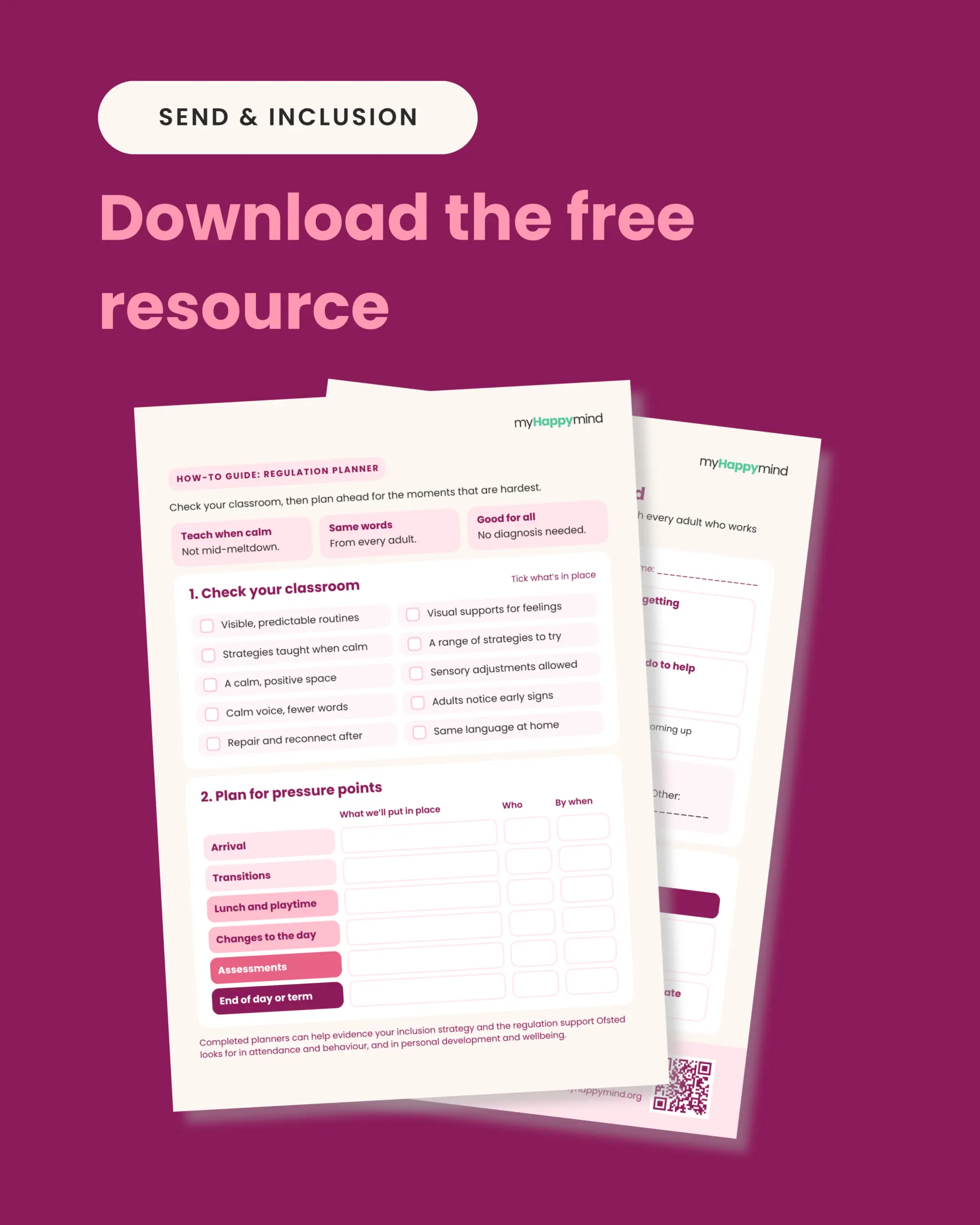
Many dysregulation incidents happen at predictable moments. Planning ahead for these pressure points can prevent a large proportion of difficulties.
Arrival. The start of the day can be hard for children who have already had a stressful morning. A consistent greeting from a familiar adult, a calm activity to settle into, and a quick feelings check-in help children transition into school.
Transitions between activities. Moving from one task or space to another is a common trigger. Countdowns, visual warnings and clear instructions about what comes next reduce uncertainty.
Unstructured times. Lunchtime and playtime can be noisy, crowded and socially complex. Quieter spaces, structured activities and trained lunchtime staff who use the same language as the classroom make a real difference.
Changes to the usual day. Supply teachers, trips, assemblies, fire drills and special events can all unsettle children who rely on routine. Advance notice and a simple explanation of what will happen help.
Assessments and tests. Pressure to perform can heighten anxiety. Familiarising children with the format, and reminding them of calming strategies beforehand, helps them cope.
The end of the day and the end of term. Fatigue builds over the day and over a term. Expect children’s capacity to cope to be lower at these times, and build in more calm and predictability.
Mapping when incidents happen for a particular child often reveals a pattern that points directly to the support they need.
Working with families
Families know their children better than anyone, and they often hold valuable insight into what helps. Regular communication about what is working at school and at home, and using the same language and strategies in both places, helps children apply what they learn across their day.
It is also important to listen when families describe distress at home that school does not see. A child who appears to be coping well at school may be using all their energy to hold things together. Reducing demands during the school day, and building in regular regulation breaks, can help.
Adapting for specialist and higher-need settings
In special schools, alternative provision and specialist units within mainstream schools, regulation support often needs further adaptation. Leaders in these settings often look for lower-stimulation versions of resources, flexible pacing for short-stay or long-stay pupils, and content that is age-appropriate for older pupils working below age-related expectations. Any universal programme should be adaptable enough to meet those needs without losing its core message.
How this links to inclusion and inspection
Teaching emotional regulation supports several of the DfE’s seven principles of inclusion, including high-quality adaptive teaching with curriculum designed for all learners, evidence-based support prioritising early intervention, and a safe and respectful culture fostering belonging, attendance and participation in learning. Schools can reflect this work in the inclusion strategy they must publish by 31 December 2026.
Ofsted’s renewed framework also looks closely at this area. In the attendance and behaviour evaluation area, inspectors consider how schools support pupils with SEND who need help with emotional regulation. In personal development and wellbeing, they look for pupils learning how to manage their own emotions and resolve conflict with others.
What the evidence shows
The Centre for Mental Health’s 2026 independent evaluation of myHappymind found that shared, neuroscience-informed language enabled pupils to explain their behaviour and apply strategies to regulate themselves. It also found the programme effective across a wide range of pupil needs, including trauma, SEN and complex backgrounds, and that it supports tailored delivery so all pupils can access the content.
Independent analysis of Bury local authority data found that persistent absence fell 7.4 times faster in myHappymind schools where 20% or more of pupils have special educational needs than in similar schools not using the programme. Like any real-world comparison, this shows an association rather than proof of cause, but it suggests that the benefits are strongest where needs are greatest.
A Year 6 teacher at Radcliffe Hall CofE Primary School describes the effect: “It has given our children with SEN a voice; they are now able to talk about their feelings.”
Where myHappymind fits
myHappymind is a whole-school wellbeing curriculum designed so that all children can access the same content together, without withdrawal or heavily differentiated delivery.
- Meet Your Brain teaches children how their brain works and how to manage strong feelings, using techniques like Happy Breathing. 98% of teachers say it has helped their class understand their brain.
- A shared language for feelings and strategies runs through every classroom, so children hear the same words from every adult.
- Inclusive tools such as symbol cards, visual timetables and an adapted curriculum for specialist settings support access for all.
- Targeted support includes a neurodiversity toolkit, alongside toolkits for separation anxiety, emotionally based school avoidance and speech and language.
- myHappymind Belong adds practical tools for SEND and inclusion, including an individual support plan generator that turns a flagged concern into a written plan for one child.
Next steps
Emotional regulation is a skill that every child can learn, with the right teaching, the right environment and adults who understand what lies behind the behaviour they see. Building it into everyday teaching, rather than treating it as an add-on for a few, helps neurodivergent pupils thrive and creates calmer, more inclusive classrooms for everyone.
If you would like to see how myHappymind supports emotional regulation for every learner, book a short live tour with our team.