


Measuring Impact & Senior Mental Health Lead Guide
Most schools invest real time and care in children’s wellbeing. Far fewer can say with confidence what difference that investment is making. For senior mental health leads, that gap matters. Without evidence of impact, it is hard to know what to keep, what to change and how to make the case for continued investment to leaders, governors and inspectors.
This guide sets out what to measure, how to measure it without adding significant workload, and how to report it in a way that is honest, useful and persuasive.
Why measuring impact matters now
Three changes have made measuring wellbeing impact more important than ever.
Inspection. Ofsted’s personal development and wellbeing evaluation area asks whether the personal development programme makes a positive difference. At the strong standard, the impact of the programme is clear in pupils’ outcomes and experiences. Inspectors are not looking for spreadsheets created for them, but they will want leaders to explain what is changing and how they know.
Funding. Schools now publish an inclusion strategy setting out how they will use their inclusive mainstream fund allocation, including intended outcomes and a review of the previous year. Wellbeing activity funded this way needs a clear line from spending to outcomes.
Accountability to families and governors. Governors increasingly ask about wellbeing, attendance and inclusion together. Families want to know what the school is doing to support their children.
Measuring impact is also simply good practice. The DfE’s learning outcomes for senior mental health leads include being able to monitor the impact of the school’s whole-school approach. One of the eight principles of a whole-school approach is identifying need and monitoring the impact of interventions.
What to measure
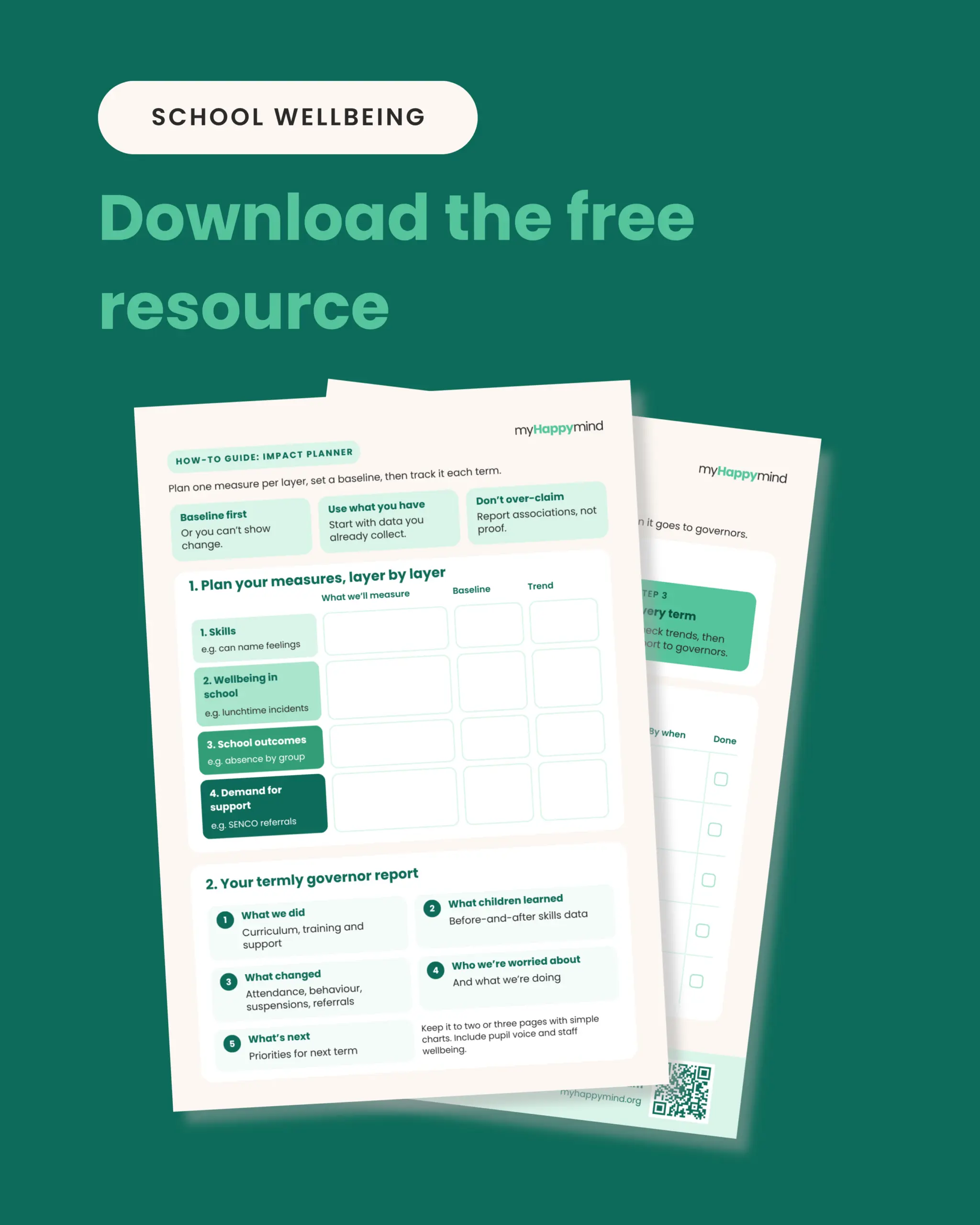
Wellbeing is complex, and no single measure captures it. A useful approach looks at four layers, moving from the skills children are learning to the outcomes those skills support.
Layer 1: skills and knowledge
Are children learning what the wellbeing curriculum teaches? Can they name their feelings, use a strategy to calm down, talk about their strengths, build positive relationships and keep going when things are hard?
This is the most direct measure of whether teaching is working, and the easiest to capture. Simple teacher observations at the start and end of a unit, short pupil reflections and class discussions all provide evidence.
Layer 2: wellbeing and behaviour in school
Are children calmer, more settled and more ready to learn? Are friendships and relationships improving? Are fewer children needing support at lunchtime or being sent out of class?
Teacher surveys, pastoral logs, behaviour records and pupil voice all help here.
Layer 3: school outcomes
Are attendance, behaviour, suspensions and attainment improving, especially for the pupils you are most concerned about? These outcomes are influenced by many factors, so they need careful interpretation, but they are the measures leaders, governors and local authorities care most about.
Layer 4: demand for additional support
Are fewer children being referred to the SENCO, to the school’s Mental Health Support Team or to specialist services? Are concerns being picked up earlier? Referral data shows whether early support is reducing the number of children whose needs escalate.
Capturing evidence without adding workload
The biggest risk in measuring wellbeing is creating a system so demanding that staff stop using it. These principles help keep it manageable.
Measure before you start. A baseline is essential. Without one, you cannot show change. Capture a simple picture of where children are before you introduce or refresh a programme.
Use what you already collect. Attendance, behaviour, suspension and referral data already exist. The task is to look at them through a wellbeing lens, by cohort and by pupil group, and over time.
Keep teacher surveys short. A handful of questions, asked at the start and end of each unit, gives far more usable data than a long annual survey few people complete.
Choose validated measures carefully. Some schools use validated wellbeing questionnaires designed for children, such as the Stirling Children’s Wellbeing Scale for older primary pupils. These can be useful, but check that a tool is designed for the age group and purpose you have in mind. Screening tools are not the same as tools for measuring whole-school impact, and any measure that might identify a child at risk needs a clear plan for follow-up.
Include pupil voice. Short conversations with a sample of pupils, or a few open questions, often reveal more than numbers alone.
Respect privacy. Wellbeing data about individual children is sensitive. Agree who can see it, how it is stored and how it will be used, in line with your data protection policies.
What before-and-after evidence looks like
Teacher survey data from schools using myHappymind in 2025/26 shows what simple before-and-after measures can reveal:
- Self-esteem. At the start of the Celebrate module, 33% of teachers said half or more of their children could talk about their character strengths. After it, 97% said their class was more able to do so, and 91% had seen children’s self-esteem and confidence improve.
- Goal-setting and resilience. At the start of the Engage module, 8% of teachers said more than half of their children knew how to set their own goals, and 15% said more than half could persevere in the face of challenges. After it, 88% had seen children getting more excited about setting goals, and 87% had seen an improvement in resilience and perseverance.
- Self-regulation. At the start of Meet Your Brain, 9% of teachers said more than half of their children had a method to self-regulate during times of stress and worry. After it, 95% said Happy Breathing had benefited their class.
At Elton Primary School, 90% of teachers said half or fewer of their pupils had a way to self-regulate before the programme. Afterwards, 100% said self-regulation tools had benefited their class.
These measures are simple, quick to collect and easy to explain to governors. They also show the direction of travel clearly.
Looking at school outcomes
Linking wellbeing work to attendance, behaviour and attainment is harder, because so many factors affect those outcomes. Comparison helps. If you can compare your school’s trend with similar schools, or compare pupils who have and have not received a particular intervention, the picture becomes clearer.
Local authorities can sometimes support this. Independent analyses of local authority data in Bury and Sefton compared schools delivering myHappymind with similar schools that do not. In Bury, persistent absence fell 7.4 times faster in myHappymind schools with high levels of SEN, and the proportion of pupils meeting the expected standard at Key Stage 2 rose 12.5 times faster across all schools analysed. In Sefton, attendance improved 2.1 times faster. The analyses are careful to describe these as consistent associations rather than proof of cause, which is the right way to present this kind of evidence.
Within your own school, the same principle applies. Look at trends over several terms rather than a single snapshot, compare groups of pupils where you can, and bring several sources of evidence together before drawing conclusions. A rise in attendance alongside improved teacher survey results and fewer pastoral incidents tells a far stronger story than any one measure on its own. It also helps to discuss the data with colleagues, including the SENCO, attendance lead and class teachers, who can often explain what the numbers alone cannot.
Measuring the impact of targeted support
Whole-school measures show the overall picture. For children receiving targeted support, such as a small-group intervention, a key adult or an individual support plan, you also need to know whether that support is working for each child.
A few simple approaches help:
- Set clear goals at the start. Agree with the child, their family and the adults involved what you hope will change, in concrete terms. “Able to come into class in the morning without becoming distressed” is easier to track than “less anxious”.
- Use short, regular check-ins. A brief weekly or fortnightly rating, completed by the child where possible and by an adult who knows them well, shows whether things are moving in the right direction.
- Look at everyday indicators. Attendance, punctuality, time spent out of class and incidents at lunchtime often show change before formal measures do.
- Review and decide. At the end of a block of support, decide whether to continue, adjust, step down to universal provision or step up to more specialist help.
Recording this consistently also builds a picture across the school of which kinds of targeted support are most effective, and for which children.
Measuring staff wellbeing
Staff wellbeing is one of the eight principles of a whole-school approach, and it shapes how well adults can support children. Nationally, 78% of education staff report being stressed by their work.
A short, anonymous staff survey once or twice a year can track how staff feel about workload, support and their own wellbeing. Asking the same few questions each time makes trends easy to see. It is important to share what you learn and what you will do in response; staff are more likely to keep completing surveys if they see action as a result.
Reporting to governors and leaders
A short, regular report is more useful than an annual document. A termly wellbeing report might cover:
- What we did. The wellbeing curriculum taught, training delivered, and targeted support provided.
- What children learned. Before-and-after skills data from teacher surveys and pupil voice.
- What changed in school. Trends in attendance, behaviour, suspensions and referrals, with commentary on what may be driving them.
- Who we are worried about. Groups of pupils whose outcomes are not improving, and what we are doing about it.
- What we will do next. Priorities for the coming term.
Keep it to two or three pages, use simple charts, and be honest about what the data can and cannot tell you. Governors value candour more than polish.
Talking about impact at inspection
When inspectors ask about personal development and wellbeing, leaders who can describe their approach clearly, explain what has changed and show a few well-chosen examples of evidence tend to be most persuasive. Inspectors will also talk to pupils, so the most powerful evidence is often children who can explain, in their own words, how they look after their wellbeing.
Ofsted is clear that it does not need schools to produce documents specifically for inspection. The aim is to have a clear understanding of your impact, not a separate evidence file.
Common mistakes
Measuring too much. Collecting data nobody uses wastes time. Start with a few measures and add more only if they are useful.
Measuring too late. Without a baseline, you cannot show change.
Over-claiming. Attributing every improvement to one programme undermines credibility. Present findings as associations, and acknowledge other factors.
Ignoring staff. Staff wellbeing affects everything else. Include it in your measures.
Forgetting to act. The point of measuring is to improve. Use what you learn to adjust provision.
Where myHappymind fits
myHappymind is built to make impact easier to see. Every module includes simple before-and-after measures, so senior mental health leads can track how children’s skills develop across the year without designing their own surveys. Staff wellbeing course data shows the impact on adults, too: 97% of staff reported improved self-confidence and self-esteem after completing it.
At a national level, our 2025/26 National Impact Report brings together data from schools across the country, the Centre for Mental Health’s independent evaluation, and independent analyses of local authority data, giving leaders a wider evidence base to draw on alongside their own.
Next steps
Measuring wellbeing impact does not need to be complicated. A baseline, a few well-chosen measures and a short termly report will tell you most of what you need to know, and give you a clear story to share with leaders, governors, families and inspectors.
If you would like to see how myHappymind helps schools track and evidence their wellbeing impact, book a short live tour with our team.