



Most schools now recognise that children’s mental health and wellbeing cannot be supported by a single intervention, a single member of staff or a single week of themed assemblies. It needs to run through everything a school does: its culture, its curriculum, its relationships with families and the way it identifies and supports children who need more.
That is the idea behind a whole-school approach. This guide explains what it means, the eight principles that underpin it, and how primary schools can build one in a way that is practical, sustainable and makes a real difference for every child.
Why a whole-school approach matters
One in five children and young people in England has a probable mental disorder. More than one million children had an active referral to children and young people’s mental health services in 2024-25, and more than one in three of those referred were still waiting for treatment.
Schools cannot replace specialist services, and they should not try to. But they are uniquely placed to do something specialist services cannot: reach every child, every day, before difficulties develop. A whole-school approach is built on that idea. It focuses on prevention and early support, taught to all children, alongside clear routes to targeted and specialist help for those who need it.
The Centre for Mental Health made this one of its five recommendations to government following its 2026 evaluation of myHappymind: support every school and college to adopt a genuine whole-school approach to wellbeing, beyond current Mental Health Support Team provision.
The eight principles
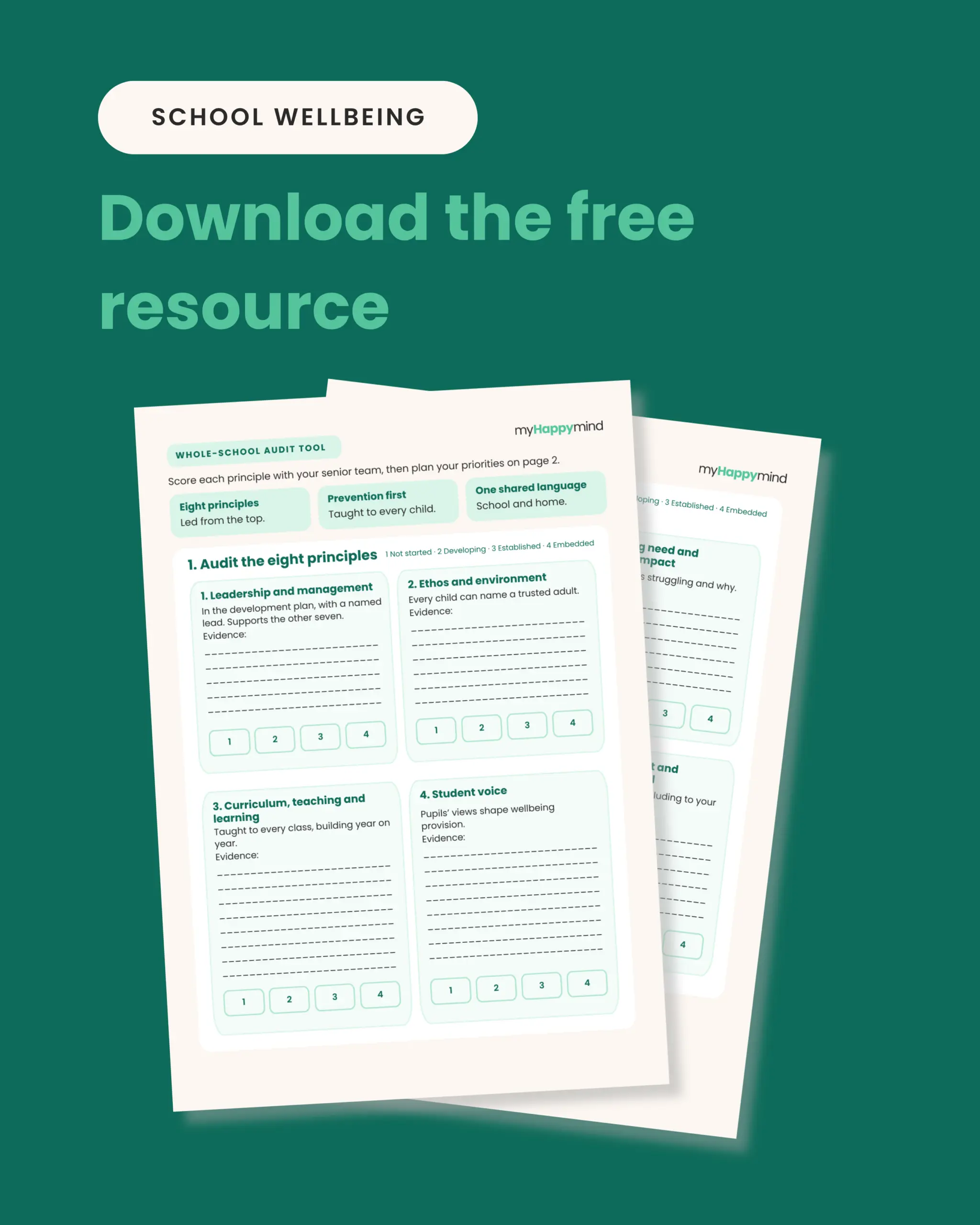
The DfE and the Office for Health Improvement and Disparities set out eight principles for a whole-school or college approach to promoting children and young people’s mental health and wellbeing. Leadership and management sits at the centre, supporting the other seven.
1. Leadership and management
A whole-school approach needs visible commitment from senior leaders and governors. In practice, that means mental health and wellbeing appear in the school development plan, a senior leader is responsible for it, and time and resources are allocated to it.
What good looks like: wellbeing is discussed at senior leadership and governor meetings, not only when there is a problem. Leaders can explain the school’s approach and how they know it is working.
2. Ethos and environment
The culture of a school shapes how children feel every day. Schools with a positive ethos value every child, promote respect and belonging, and create calm, predictable environments where children feel safe.
What good looks like: children can name a trusted adult. Staff notice and recognise children’s strengths. Routines are predictable and expectations are consistent.
3. Curriculum, teaching and learning
Children need to be taught about mental wellbeing, not only supported when they struggle. A planned, sequenced curriculum teaches children how their brain works, how to recognise and manage their emotions, how to build positive relationships and how to cope with setbacks.
What good looks like: wellbeing is taught regularly to every class, building year on year. Children use a shared language for feelings and strategies across the school.
4. Student voice
Children’s views should shape the school’s approach. Asking pupils what helps, what worries them and what they would change makes provision more relevant and helps children feel heard.
What good looks like: pupil surveys, school council discussions and conversations with pupils inform decisions about wellbeing provision.
5. Staff development, health and wellbeing
Staff need the knowledge and confidence to support children’s wellbeing, and they need their own wellbeing to be looked after. Staff who are stressed and exhausted find it far harder to stay calm and responsive with children.
What good looks like: every adult, including support staff, receives training in children’s wellbeing. Staff workload and wellbeing are actively considered by leaders.
6. Identifying need and monitoring impact
Schools need ways to identify children who may need more support, and to check whether their approach is making a difference. This means using a range of information, including attendance, behaviour, pastoral records and wellbeing measures.
What good looks like: the school knows which children are struggling and why, and can show how wellbeing has changed over time.
7. Working with parents and carers
Families are children’s first and most important source of support. Sharing what children learn in school, and the strategies they use, helps families reinforce that learning at home.
What good looks like: parents understand the school’s approach to wellbeing, know the language children use and know how to raise concerns.
8. Targeted support and appropriate referral
Some children need more than the universal offer. A whole-school approach includes clear processes for identifying these children, providing targeted support in school, and referring to specialist services when needed.
What good looks like: staff know the referral pathways, including to the school’s Mental Health Support Team where one is in place. Targeted support uses the same language as the whole-school approach.
The role of the senior mental health lead
Many schools have a designated senior mental health lead, responsible for developing and overseeing the school’s whole-school approach. The DfE has offered grant-funded training for senior mental health leads in eligible schools, aligned to the eight principles and covering how to lead strategic change, identify need, and monitor the impact of the school’s approach. Schools should check the current availability of grant funding.
The senior mental health lead does not need to deliver everything personally. Their role is strategic: understanding where the school is now, planning improvements across the eight principles, and making sure the approach is sustained over time.
Mental Health Support Teams
Mental Health Support Teams (MHSTs) provide early help for children with mild to moderate mental health needs and support schools to develop their whole-school approach. In June 2026, the government reported that nearly six million children and young people could access an MHST through their school or college, with full coverage planned by the end of 2029.
MHSTs and whole-school approaches work best together. MHSTs offer targeted support and specialist expertise. A whole-school approach makes sure every child is taught the skills to look after their wellbeing, and that children who need more are identified early. The Centre for Mental Health recommended stronger links between universal wellbeing programmes and MHSTs, joining up prevention with specialist provision.
What it looks like in a typical week
It can help to picture what a whole-school approach looks like day to day in a primary school.
On Monday morning, a teacher starts the day with a short check-in, asking children to name how they are feeling using the words they have learned. A child who says they feel worried is quietly offered a moment with a trusted adult.
On Tuesday, every class has a wellbeing lesson. Year 2 are learning about how their brain responds when they feel scared. Year 5 are exploring how to set a goal and keep going when it gets hard. The lessons build on what children learned last year, using the same characters and language.
On Wednesday, a lunchtime supervisor notices two children arguing. Instead of simply separating them, she reminds them of the strategy they have learned to stop, understand each other’s point of view and consider what to do next.
On Thursday, staff spend fifteen minutes of their briefing on a short CPD session about supporting children who are anxious about coming to school. The senior mental health lead shares this term’s attendance and wellbeing data.
On Friday, a celebration assembly recognises children’s character strengths, not only their achievements. Parents receive a short message explaining the strategy children have practised this week, so they can use it at home.
None of these moments is dramatic. Together, they create a school where children understand their feelings, have strategies to manage them, feel connected to the adults around them and know where to turn when they need help.
Common pitfalls
Schools that struggle to build an effective whole-school approach often fall into one of a few traps.
Relying on one person. When wellbeing depends on a single passionate member of staff, it can disappear when they leave. Sustainable approaches are built into systems, roles and the curriculum.
Doing lots of separate things. A collection of unconnected initiatives, each with its own language, can confuse children and exhaust staff. A coherent approach, with one shared language, is easier to sustain and more effective.
Focusing only on children in crisis. Responding well to crises is essential, but if all the effort goes there, prevention gets squeezed. The aim is to reduce the number of children who reach crisis in the first place.
Forgetting staff. Asking staff to support children’s wellbeing without attending to their own is unsustainable.
Not measuring impact. Without a way to see what is changing, it is hard to sustain commitment or make the case for continued investment.
Getting started: a five-step plan
If you are building or refreshing your school’s approach, these five steps provide a practical starting point.
- Audit where you are now. Use the eight principles to review current practice. Free audit tools are available to help.
- Agree your priorities. Choose two or three areas to focus on this year, rather than trying to change everything at once.
- Put the foundations in place. For most schools, a planned wellbeing curriculum taught to every class, and training for every adult, are the foundations everything else builds on.
- Involve pupils, staff and families. Ask for their views, share your plans and explain the shared language you will use.
- Measure and review. Agree how you will know whether your approach is working, and review progress each term.
How this links to inspection and inclusion
A whole-school approach also supports a school’s work in other areas. Ofsted’s personal development and wellbeing evaluation area looks for a coherent personal development programme, effective pastoral support, and pupils who are developing the confidence, resilience and knowledge to keep themselves mentally healthy. The DfE’s principles of inclusion, which schools now use to plan their inclusive mainstream fund spending, include a safe and respectful culture fostering belonging, and evidence-based support prioritising early intervention.
Where myHappymind fits
myHappymind is designed as a whole-school approach. It brings together several of the eight principles in a single programme, with one shared language:
- Curriculum, teaching and learning. Five science-based modules, Meet Your Brain, Celebrate, Appreciate, Relate and Engage, are taught across the whole school as a spiral curriculum, with ready-to-teach lessons, displays and assemblies.
- Ethos and environment. A shared language for feelings and strengths runs through every classroom. 97% of teachers say they are now having one to three conversations about children’s mental health each week.
- Student voice. Happiness Heroes are pupil ambassadors who help lead the whole-school approach and give children a voice in their school’s wellbeing.
- Staff development and wellbeing. Staff CPD and a staff wellbeing course help adults support children and look after themselves. 99% of staff reported a better understanding of their brains, emotions and what they can do to improve their own wellbeing.
- Working with parents and carers. The Parent App shares the same language and strategies with families of primary-age children.
- Targeted support. Courses and toolkits for children who need more, using the same language as the whole-school programme.
- Monitoring impact. Before and after measures for each module help schools see what is changing.
The Centre for Mental Health’s 2026 evaluation found children better able to understand, articulate and manage their emotions, and schools better equipped to address need before it escalates. As the Headteacher of Tadley Community Primary School puts it: “myHappymind is far more than a wellbeing curriculum; it is a culture-building tool.”
Next steps
A whole-school approach is a process, not a one-off project. The schools that sustain it are those that build wellbeing into their culture, curriculum and systems, and keep reviewing what is working.
If you would like to see how myHappymind supports a whole-school approach in schools like yours, book a short live tour with our team.