
For school leaders, the question has shifted. It is less about whether wellbeing is on the agenda, and more about whether you can show what you do, how it is planned, and the difference it makes for every pupil.
What has changed
Single-word overall judgements have gone. Instead, schools receive a report card with a grade for each evaluation area: inclusion, curriculum and teaching, achievement, attendance and behaviour, personal development and wellbeing, leadership and governance, and early years or post-16 where relevant. Safeguarding is judged as met or not met.
Each area is graded on a five-point scale: urgent improvement, needs attention, expected standard, strong standard and exceptional. The expected standard is the starting point for inspectors’ thinking, and Ofsted expects most schools to reach at least that standard in each area.
Inclusion is now a standalone evaluation area and also runs through all the others. The September 2026 toolkit update added clarity on several points, including the role of the SENCo, support for pupils with an education, health and care plan to attend and behave well, and inclusion strategies. Under the DfE’s inclusive mainstream fund conditions, every school must publish an inclusion strategy by 31 December 2026, and inspectors will look at how it sets out the use of the school’s funding to meet the needs of its pupils.
What inspectors look for in personal development and wellbeing
-
developing pupils’ confidence, resilience and knowledge so that they can keep themselves mentally healthy
-
developing character, so pupils reflect wisely, behave with integrity and cooperate consistently well with others
-
teaching pupils how to manage their own emotions and resolve conflict with others
-
an age-appropriate understanding of healthy relationships
-
pastoral support that is well matched to pupils’ needs, dealing with immediate issues and underlying ones so problems do not recur
Inspectors also look at strategic leadership. They consider whether the personal development programme is broad, coherently planned and suited to the school’s context, and whether staff have the knowledge and skills to teach it, in line with the best available evidence.
To meet the expected standard, a school needs a coherent programme of personal development across the taught curriculum and wider opportunities, a well-taught relationships and health education programme, and effective pastoral support that pupils feel confident to use. The personal development programme must be an entitlement for every pupil, with reasonable adjustments so that pupils with SEND, disadvantaged pupils and others facing barriers can take part.
The strong standard goes further. Pupils are confident, resilient and independent. Leaders anticipate which pupils may need extra pastoral support. And the impact of the personal development programme is clear in pupils’ outcomes and experiences.
Wellbeing runs through other areas too
Wellbeing is not confined to one evaluation area. In attendance and behaviour, the strong standard describes pupils who learn how to manage their own emotions and resolve conflict. When looking at support for pupils with SEND, inspectors also consider how schools help those whose emotional or mental health needs affect their attendance, and those who need extra support with emotional regulation.
In inclusion, inspectors look for early, accurate identification of need and a published inclusion strategy setting out how the school’s funding, including the inclusive mainstream fund, will be used to meet the needs of its cohort.
The updated statutory guidance for relationships, sex and health education also came into force on 1 September 2026, with strengthened content on mental health. A well-taught RSHE programme is part of the expected standard for personal development and wellbeing.
How to evidence it without adding to workload
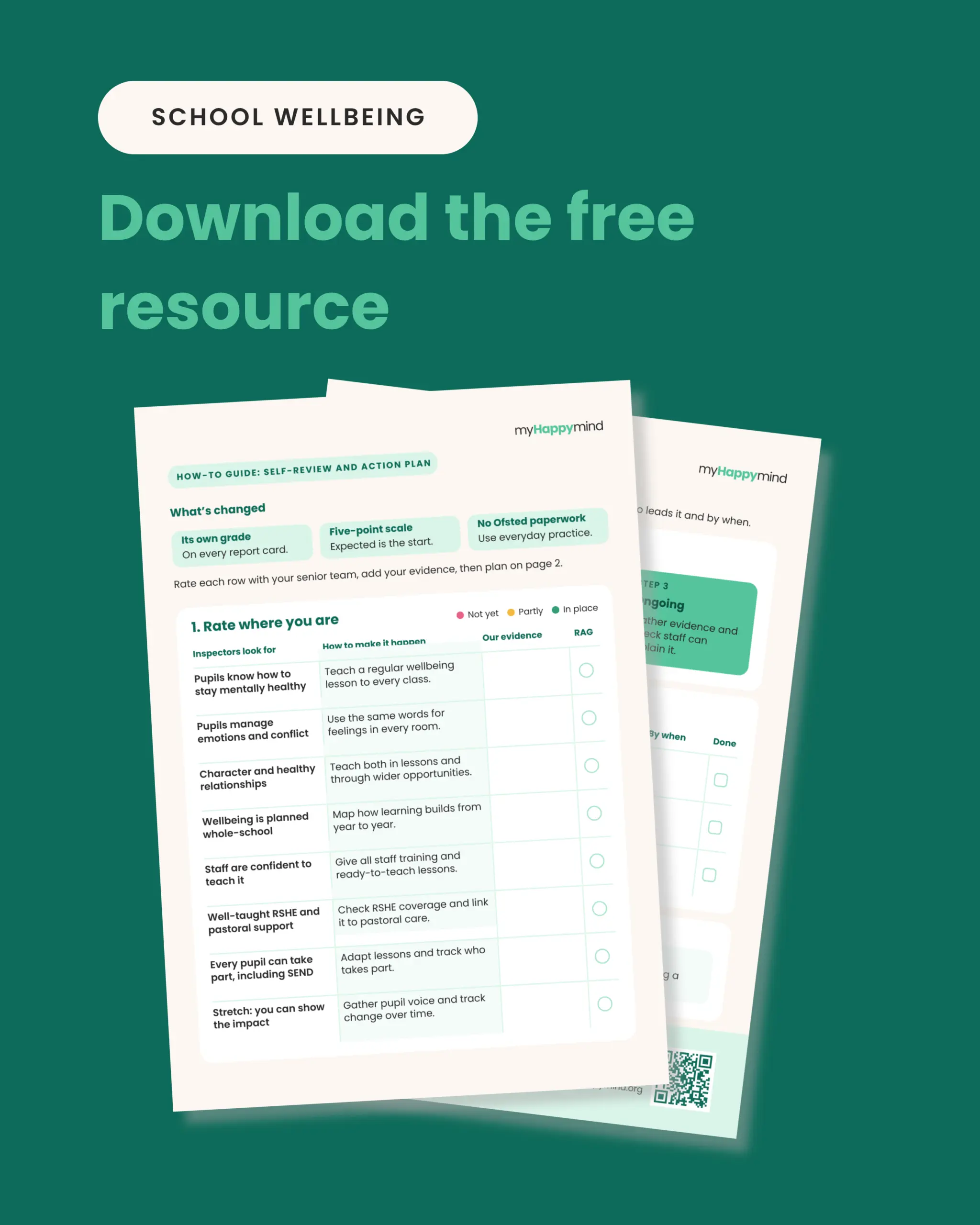
Ofsted is clear that it does not need schools to produce documents specifically for inspection. Inspectors gather evidence mainly through professional conversations and by seeing the day-to-day work of the school. So the most useful evidence is the evidence your normal practice already creates. Five questions are worth asking now:
- Is wellbeing planned and sequenced across the whole school? A spiral curriculum, revisited each year, shows coherence far more clearly than one-off assemblies or themed weeks.
- Can pupils explain what they have learned? Inspectors talk to pupils. A shared language for feelings and strategies, used across every classroom, means children can describe how they look after their own wellbeing.
- Are staff confident to teach it? Training and ready-to-teach resources help every adult deliver the programme consistently, not just the PSHE lead.
- Do you know what has changed? Simple before-and-after measures, pupil voice and links to attendance, behaviour and pastoral data show impact over time.
- Are families involved? Inspectors look at how schools work with parents. Sharing the same language and strategies at home strengthens what happens in school.
Where myHappymind fits
-
Meet Your Brain: how the brain works, and self-regulation strategies such as Happy Breathing
-
Celebrate: Character Strengths, confidence and self-esteem
-
Appreciate: developing an Attitude of Gratitude
-
Relate: Active Listening and positive relationships
-
Engage: setting goals and building resilience and perseverance
-
A coherent, planned programme. A spiral curriculum, revisited each year, shows that personal development is broad, coherently planned and sequenced across the whole school.
-
Pupils who can explain their learning. Lessons revisit previous learning and give children regular time to talk, so pupils can describe in their own words how they look after their wellbeing when inspectors speak to them.
-
Wider opportunities for pupils. Through the Happiness Hero scheme, pupils act as Mental Health Ambassadors, helping others use the strategies they have learned. Inspectors can meet them and hear first-hand how wellbeing works across the school.
-
An entitlement for every pupil. Adapted resources and targeted support help pupils with SEND and those facing other barriers take part fully.
-
Staff with the knowledge to teach it. Staff CPD and ready-to-teach lessons help every adult deliver the programme consistently, in line with the best available evidence.
-
Families involved. The Parent App shares the same language and strategies at home, strengthening what happens in school.
-
RSHE covered. Schools that add myHappymind PSHE get 100% statutory PSHE coverage, including RSHE, kept up to date as requirements change.
Next steps
The renewed framework rewards schools that can show a coherent, inclusive approach to wellbeing with clear impact. If you are reviewing your provision ahead of inspection, a short live tour will show you how myHappymind works and how other schools use it as evidence.