Every mainstream primary school in England now has ring-fenced funding to support inclusion, and a statutory inclusion strategy to publish by 31 December 2026. This comes at a time when SEND and inclusion needs in mainstream classrooms have been rising steadily, with social, emotional and mental health needs among the most common areas of need. Leaders are being asked to meet more need with the same time and team.
Most schools we speak to are already doing good work here. The question they are asking is a practical one: is there an inclusion programme that can we trust to cover the gaps well, evidence it properly, and do it without adding to an already full plate?
This post introduces myHappymind Belong, our inclusion programme for primary schools, and explains why schools are choosing it to support their work under the Inclusive Mainstream Fund. If you would like a refresher on the fund itself, our guide to what the Inclusive Mainstream Fund is covers the allocations and the December deadline in full.
Built on a proven programme
When funding is tied to a statutory strategy, the credibility of your chosen programme matters as much as its content. Governors and Ofsted will ask what your provision is, and what evidence sits behind it.
myHappymind is used in over 2,000 schools and settings across the UK. Our whole-school approach to wellbeing is NHS-backed: we are part of the NHS Innovation Accelerator, a member of the NHS Confederation, and we have been commissioned by the NHS and local authorities in 50 areas. Our impact has been independently validated by the Centre for Mental Health and the University of Chester. Along the way our work has been recognised with the King’s Award for Enterprise, a BESA Award, and the Bett 2026 Transformational Impact Award.
What's included in myHappymind Belong
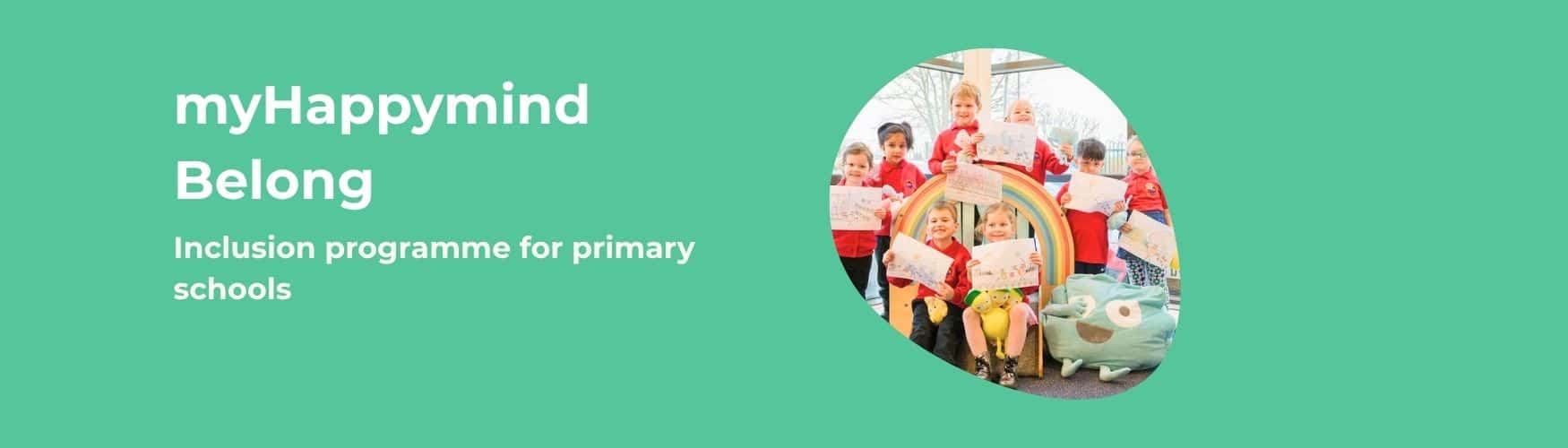
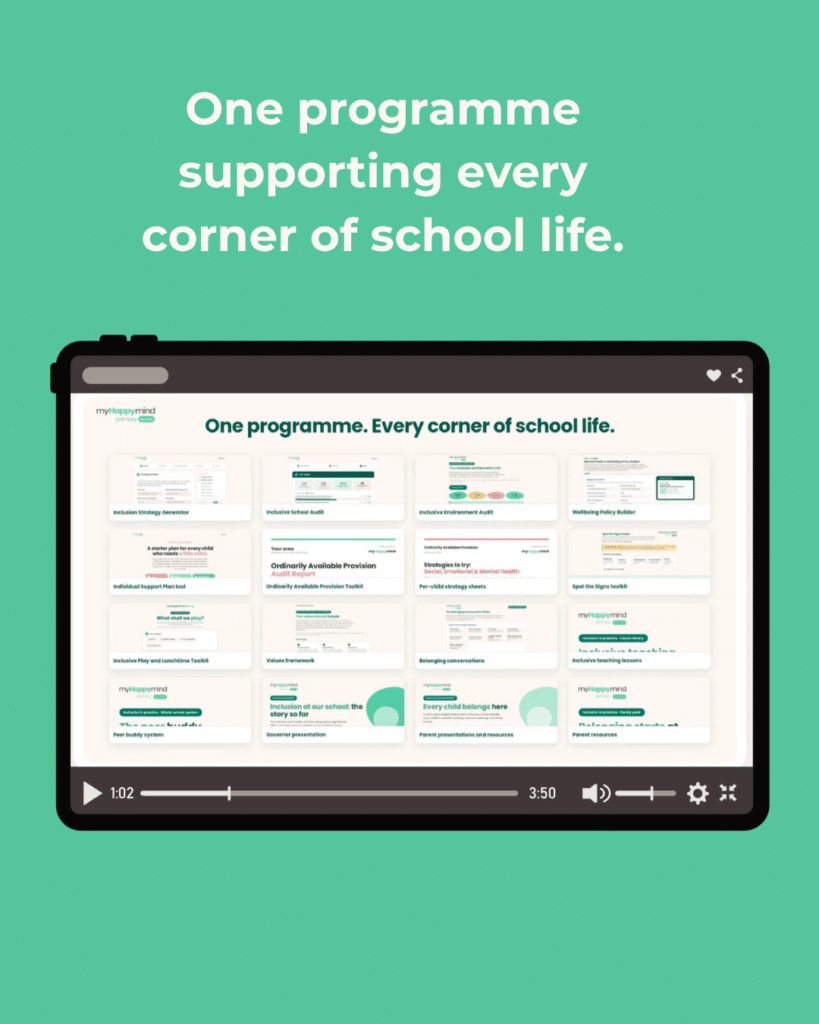
Belong is our inclusion programme for primary schools. It builds on our wellbeing programme and gives staff practical tools to support every child, including those with additional and SEND needs. It includes:
- A customisable inclusion strategy template tool, aligned to the 7 Department for Education inclusion themes and ready for governor sign-off
- A whole-school inclusion audit tool to baseline your current provision against each theme
- An Individual Support Plan (ISP) builder, with a menu of practical adaptations
- A staff training series, including a Spot the Signs toolkit that helps all staff notice early signs of need
- Everyday classroom and playtime toolkits, such as inclusive lunchtimes, a peer buddy scheme and a pupil question box
- Family-facing content and a governor presentation pack to support sign-off
- An inclusive environment audit checklist and classroom setup guidance
- A staff language guide of strengths-based, co-regulation-informed scripts.
- And much more…
Belong sits alongside the myHappymind wellbeing programme, so it strengthens your inclusion work without adding a separate, disconnected initiative for staff to learn.
How myHappymind Belong Maps to the 7 Inclusion Themes
The inclusion strategy the DfE expects you to publish is built around the seven DfE inclusion themes (from the February 2026 Schools White Paper framework):
- Ambitious leadership and governance
- Evidence-based support prioritising early intervention
- High-quality teaching for all learners
- Accessible, enriching provision beyond the classroom
- Safe and respectful culture fostering belonging
- Strong partnerships with families and wider services
- Inclusive environments with continued accessibility
myHappymind Belong gives you the practical tools to meet the seven themes and produce your strategy in time for the December deadline.
Our free inclusion strategy checklist is a good way to see where you stand against the seven themes before you start.
An Evidence-Led Approach
All our programmes are science-led. Here are some of what schools and independent evaluations report about our NHS-backed wellbeing programme:
- 100% of schools said myHappymind has contributed to positively supporting children with SEN or SEMH needs (Hampshire and HIOW Return on Investment reports, 2025).
- 87% of schools reported a reduction in SENCO referrals, and analysis in Kirklees found the approach returns around 10 full working days a year to SENCOs.
- Schools using myHappymind saw an 83% lower rise in suspensions than comparison schools in an independent Portsmouth Council study, and half the rate of rise in severe persistent absence.
- In Bury, an independent analysis of local authority data across four academic years found myHappymind schools reduced persistent absence at 7.5 times the rate of comparison schools.
- 90% or more of schools rate the programme’s impact on pupil behaviour as good or excellent (customer research, 2025).
These are the outcomes that inclusion funding is meant to support: fewer children waiting for help, calmer classrooms, and staff time returned to the people who need it. myHappymind Belong deepens inclusion support and strengthens the proven impact of our wellbeing programme
How It Can be Funded
Belong uses a small proportion of schools overall Inclusive Mainstream Fund allocation, while delivering impact at both whole-school and intervention level. That leaves the majority of your funding available for other inclusion priorities such as classroom adaptations, teaching assistant training and family engagement work.
To see the numbers for your school, our Inclusive Mainstream Fund calculator estimates your likely allocation and shows how Belong could fit within it.
A Simple Next Step
Schools that find December straightforward will be the ones that go into the autumn term with a clear picture of their provision, a strategy template ready to populate, and a programme they trust to cover any gaps.
myHappymind Belong is available from September. You can take a tour of myHappymind Belong to see the strategy template, audit tool and toolkits for yourself.
A short conversation is the easiest place to start. We can show you your school’s estimated allocation, walk through how your provision maps to the seven themes, and share the strategy template that takes the bulk of the December workload off your desk.
Complete the form and
watch the overview
If it helps, we can share the audit template and walk you through Belong’s strategy builder before term ends. Book a discovery call to find out more.
Interested in Finding out More?
Already a myHappymind school? Contact your Customer Happiness Manager or email hello@myhappymind.org to get started.
New to myHappymind? Book a call with our team today:
Frequently Asked Questions
myHappymind Belong is an inclusion programme for primary schools, available from September. It aligns with the 7 Department for Education inclusion themes and includes a pre-populated inclusion strategy template, a whole-school inclusion audit tool, an Individual Support Plan builder, a staff training series and everyday classroom toolkits. It builds on the NHS-backed myHappymind whole-school wellbeing programme, used in over 2,000 schools.
Yes. The Inclusive Mainstream Fund is ring-fenced for inclusion, and the DfE’s guidance makes clear that schools can use it for staff training, specialist programmes, family engagement and curriculum resources that are directed toward the seven inclusion themes. For many primary schools, Belong uses only a small proportion of their allocation.
Yes. myHappymind is part of the NHS Innovation Accelerator and a member of the NHS Confederation, and it has been commissioned by the NHS and local authorities in 50 areas. Its impact has been independently validated by the Centre for Mental Health and the University of Chester.
Yes. Belong provides a ready-to-use inclusion strategy plus the tools that map against the seven themes, so you can document and publish a strategy and access all the necessary tools to support delivering it.
If you use myHappymind, you are already delivering against many of the inclusion themes. myHappymind Belong formalises that work into strategy documentation and adds specialist inclusion resources and staff training. Speak to your Customer Happiness Manager to see what is already covered and what Belong would add.