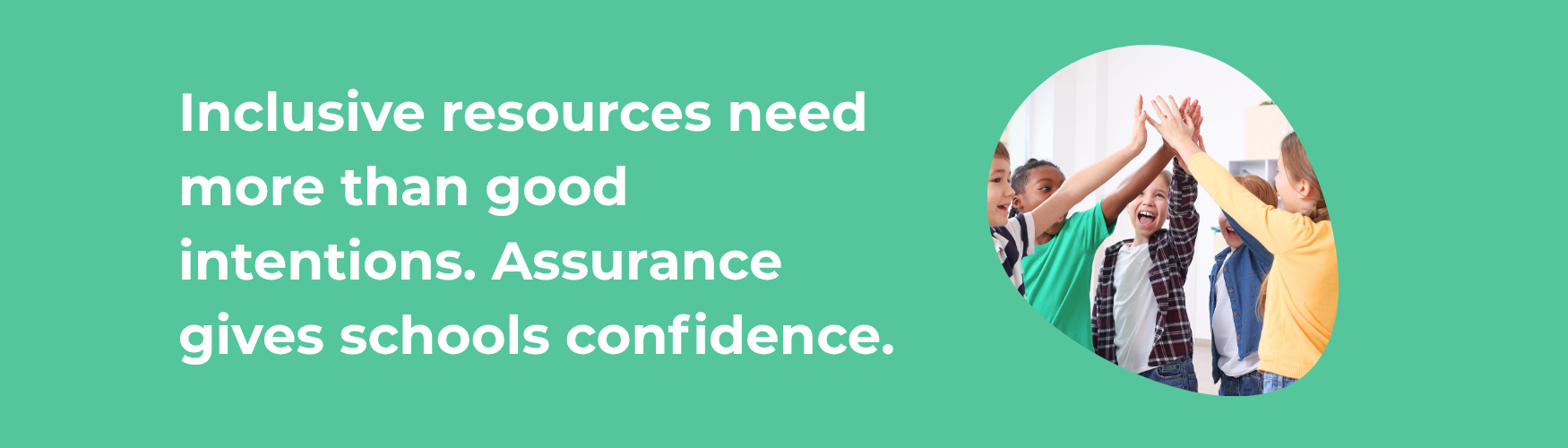
Accessibility and inclusion already shape everything we build. Having nasen, the National Association for Special Educational Need scheck our resources independently against their framework means it’s not just us saying so.
Why this matters for all settings
Inclusion became a named Ofsted evaluation area for the first time in November 2025. That means SENCOs and headteachers are being asked to effectively demonstrate that what they use with children works for every learner.
What nasen Assured status means
nasen’s Quality Framework review checks things like whether a resource is genuinely evidence-informed, whether the language and images used are inclusive, whether it is accessible in practice rather than in theory, and whether it is easy for staff to pick up and use. It is an external check, not our own view of our own work.
What this covers
Accessibility and inclusion already shape how we design every resource we make. What’s different with Speech and Language Toolkit and myHappymind Places is that this has now been checked independently against nasen’s framework,which means schools don’t just have to take our word for it.
Why this matters to us
Equitable access is not something we say once and move on from. Every school and setting is different, and every learner using our resources has different needs. Having a specialist body outside myHappymind check that against their framework, and tell us honestly what to change, is exactly the kind of scrutiny we think schools and settings deserve from anyone asking for their trust.
“Equitable access has to mean more than good intentions. It means having someone outside myHappymind check that these resources actually work for the settings and learners they’re meant to serve, and tell us honestly where they didn’t yet. That’s what this process gave us, and it’s why we take it seriously.”
Katie Ingham, Head of Content
nasen reviewed two of our resources, our Speech and Language Toolkit and myHappymind Places, our self-regulation toolkit, and confirmed both as nasen Assured:
“Three [speech and language] toolkits guide staff and parents in supporting children’s speech and language across early development, fluency, and social interaction. Designed to bridge long NHS waiting lists, they offer interactive activities that build communication skills, confidence, and social interaction, creating consistent, language-rich support across school and home.”
“myHappymind Places supports children to build a personalised self-regulation toolkit by identifying their Happy, Middle and Busy Places. It deepens emotional understanding, helping children recognise feelings and their impact on mind and body, and apply practical strategies to manage emotions, building resilience, independence, and confidence to navigate daily challenges.”
Interested to find out more?
If you’d like to see how the Speech and Language Toolkit or myHappymind Places could work in your school or setting, get in touch: book a call or email us at hello@myhappymind.org.
Our Speech and Language Toolkit and myHappymind Places, are delivered as part of our NHS-backed whole-school wellbeing programme. Find out more here.
Frequently asked questions
nasen Assured is a status nasen, the National Association for Special Educational Needs, awards to a resource after independently reviewing it against their Quality Framework, covering evidence-informed content, accessibility, inclusive language and design, and clear user guidance.
Two: the Speech and Language Toolkit and myHappymind Places, a targeted course which supports and improves self-regulation.
No. It currently applies to these two resources specifically, not the wider myHappymind programme.
nasen is the National Association for Special Educational Needs, a UK charitable membership organisation that supports professionals working with children and young people with SEND. Source
For us, it means every school and setting, whatever its budget or context, and every learner, whatever their needs, can genuinely access and use what we build, not just in theory. That’s why accessibility, inclusive language and design are things we build in from the start, and why having them checked independently against a framework like nasen’s matters to us.