Independent national evaluation confirms myHappymind's impact on children's wellbeing and school culture
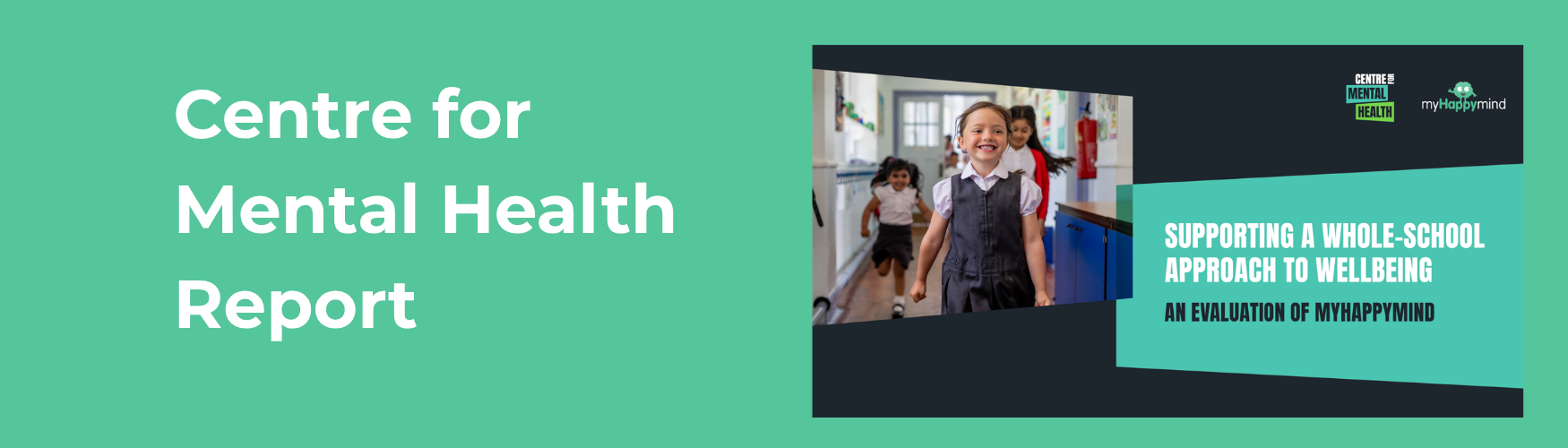
Centre for Mental Health has independently evaluated myHappymind. Here’s what they found.
myHappymind is a whole-school mental health and wellbeing programme used in over 2,000 primary schools across the UK. In May 2026, Centre for Mental Health published the latest in a series of independent evaluations of the programme, drawing on surveys from teachers, headteachers, parents and children across two locations, alongside in-depth interviews with commissioners and school leaders. The findings further strengthen an already established evidence base, and are directly relevant to commissioners and school leaders making decisions about mental health, wellbeing or inclusion provision.
What the research found
Across all five myHappymind modules, teachers reported measurable improvements in children’s emotional regulation, self-esteem, confidence and readiness to learn. The results held regardless of location, school size or pupil background.
The findings were consistent across every module. Teachers reported that children developed stronger self-regulation skills, a greater awareness of their own character strengths, more habitual expressions of gratitude, improved active listening, and greater resilience and perseverance when working towards goals. Headteachers and SENCOs completing return on investment surveys pointed to broader school-level benefits: a happier, calmer environment, stronger staff understanding of mental health, positive impacts on attendance, and indications of reduced referrals to CAMHS and other specialist services, including improved support for children with SEND and SEMH needs
What commissioners told us
An NHS Hampshire and Isle of Wight Integrated Care Board commissioner interviewed for the report was direct about the value of the programme:
“I’d say to date it does justify the investment made. I think the key thing from our perspective is around that sort of impact of changing the culture of schools, around emotional health and wellbeing and sort of really embedding that whole school approach.”
That kind of culture shift is hard to achieve and even harder to sustain. The data from Bradford, where schools have been running myHappymind for two years longer than those in HIOW, suggests it deepens over time.
Why this matters now
This evaluation lands at a significant moment for school mental health provision. The Schools White Paper 2026 sets out plans for a more inclusive mainstream system. SEND reform is accelerating. Mental Health Support Teams are expanding towards national coverage. And NICE guideline NG223 recommends universal, whole-school approaches to social, emotional and mental health as standard practice.
myHappymind is already aligned with each of these agendas. Centre for Mental Health recommends that policymakers embed positive psychology-based wellbeing interventions in schools as part of the government’s commitment to specialist mental health support for all children.
As one headteacher put it: “It is absolutely critical to keep delivering myHappymind in schools, particularly in disadvantaged areas as not only is it reducing waitlists to specialist services now, the significant impact will be seen in the long term health of individuals, communities and society as a whole.”
The evidence base keeps growing
This evaluation builds on a strong foundation of independent evidence. A 2023 Real World Validation by the University of Chester found consistent positive impacts on children’s resilience, self-esteem, self-regulation and overall mental wellbeing. A 2025 independent Portsmouth City Council case study found lower rates of persistent absence and suspensions in myHappymind schools compared with those not using the programme. Centre for Mental Health evaluation now adds a national, multi-stakeholder layer to that picture, with consistent findings across two demographically distinct locations and across every module of the programme.
What the research is built on
myHappymind is grounded in positive psychology and neuroscience, and this evaluation adds to a growing body of evidence that approaches rooted in these disciplines can make a real difference when they are embedded consistently across school life and delivered by trained staff. Centre for Mental Health also identified opportunities to strengthen future evaluation, including more consistent data collection across locations, longer-term follow-up after delivery, and the use of validated wellbeing measures directly with children. myHappymind is already acting on these recommendations, with plans to introduce the Stirling Children’s Wellbeing Scale across schools by September 2026.
“This report matters because independent scrutiny is what separates real evidence from noise. Children are calmer, more confident, better equipped to understand themselves and each other. What strikes me most in this report is the data on pupils with SEND and SEMH needs. These are children who are often written off by universal programmes. The fact that teachers are seeing strong results for them too is exactly why we built the programme the way we did, and why inclusion sits at the heart of everything we’re developing next.”
Laura Earnshaw, CEO, myHappymind.
The full Centre for Mental Health report is available now. If you are a commissioner, local authority, or integrated care board exploring how to meet your mental health and inclusion obligations in schools, it is worth a read.
Email hello@myhappymind.org or book a call to talk to the team below:
Frequently asked questions
Centre for Mental Health found consistent, positive impacts across all five myHappymind modules in two demographically different locations. Teachers reported improvements in children’s emotional regulation, self-esteem, confidence, gratitude, listening skills and resilience. Headteachers identified broader benefits including a calmer school culture, improved staff understanding of mental health, and positive impacts on attendance and specialist referrals.
Centre for Mental Health conducted an independent evaluation of myHappymind, drawing on data collected from schools across Hampshire, the Isle of Wight and Bradford, covering over 70,000 children. The evaluation included surveys from teachers, headteachers, parents and children, as well as interviews with commissioners and school leaders.
myHappymind is designed to support all pupils within the mainstream classroom, including those with SEND and SEMH needs. The programme aligns with the Schools White Paper 2026, NICE guideline NG223, and the government’s whole-school approach to mental health and wellbeing. myHappymind Belong, launching September 2026, is our dedicated inclusion strand developed specifically to support schools in building inclusive practice and meeting the demands of the new SEND landscape. Our dedicated inclusion strand, myHappymind Belong, launches in September 2026 for schools looking to go further on inclusion.